I had no clue that the game I needed was Tackle for Loss, but now I do.
Gritty and captivating, Tackle for Loss is Hotline Miami playing by the four-down rules of American football, and with an aesthetic and story rooted in football’s golden arcade era. It’s all the result of a six-year-long Hail Mary by Berlin-based 3D artist Daniel Wichterich to escape the monotonous nature of the advertising world and prove to his son that video games are a viable career path.
A CTE Story
Tackle for Loss puts you in the hazy control of Joe Bradshaw, whose story is murky, and a seemingly CTE-fueled discovery that the last five years of his life are a mystery.
In that time, he won a football championship, partied a little too hard, crashed his car, and lost his young daughter, resulting in a divorce and the total collapse of his football fantasy.
The player takes control of Joe as he wakes up in a basement below the garage of his Miami mansion.
In the main building, a mysterious being known only as Joe’s Subtenant guides Joe through rooms in the mansion that emulate memories of the moments Joe has forgotten.
As Joe navigates these rooms, the Subtenant helps him gain perspective on who he should chase down next: John Wick with a football style.
And Joe is ready to throw out that payback in a way worthy of Al Pacino’s pep talk from Any Given Sunday.
Throwing out payback
American Football really comes into play through a “four downs” mechanic, where Joe has four attempts to deliver his sweet revenge to those within a stage.
Having a limit on the number of punches and footballs Joe can throw out means that Tackle for Loss becomes less Hotline Miami and more Katana Zero in function—a game that also seems to inspire it here.
You’ll have to think about how you move Joe to clear stages.
An enemy attack is a one-hit KO, forcing you to restart the stage.
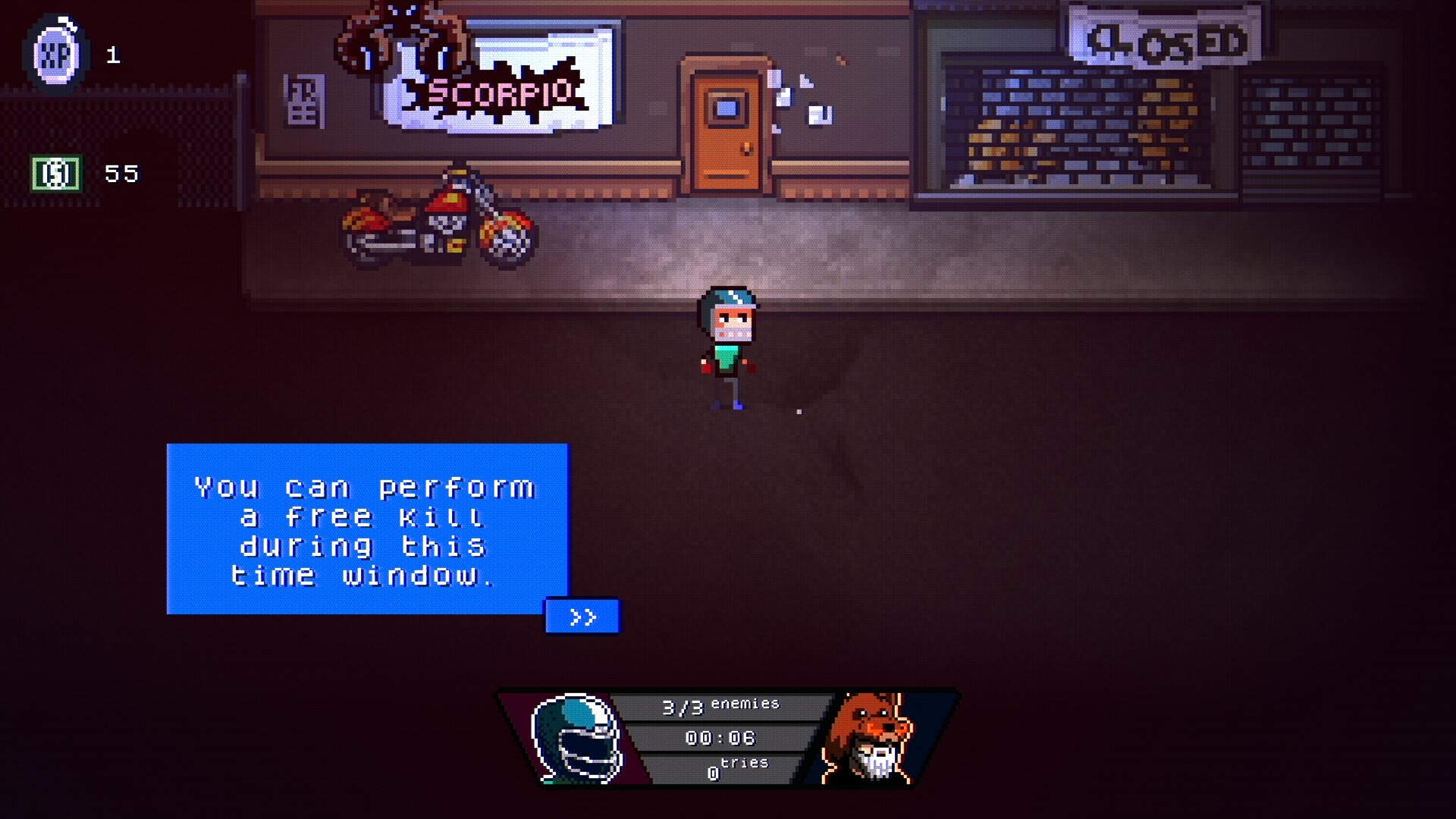
Some enemy types, like the guard dog, require a punch from the side or back or a skill like a football throw.
On the other end of Joe’s mansion is an arcade wing where you can open doors with coins dropped by defeated foes to unlock game cabinets that teach skills such as the sliding punch.
The money you get for completing stages can also be used in Joe’s basement to improve him, but this feature is not yet available in the demo.

While it was tough for me to gauge in the demo, it appears that stages are judged by the time taken to complete and the number of resets you take.
It would appear that money is handed out on a sliding scale based on performance.
While I am unquestionably in love with Tackle for Loss‘s technical mechanics, boss battles are one thing I feel is lacking in this demo.

Each group of stages focuses upon Joe making his way to someone who he understands to be complicit in the loss of his daughter.
Reaching these people and interacting with them causes Joe to issue a one-liner before they tell him who to find next. Then, he disappears as the screen flashes, and Joe wakes up again in his basement.
I can’t help but feel that as cool as a one-liner is, a boss battle where a single hit does you would be even better. Maybe it could revolve around a skill you should have by that stage.
Tackle for look
Visually, Tackle For Loss hits hard at the 8-bit aesthetic that calls back to the late ’80s days of Tecmo Bowl, with elements of pixel grunge present in indie darlings like Super Blood Hockey.
In short, it’s bloody comforting to look at.
Colours start warm with that classic Miami night vibe, but darkness creeps in as Joe’s mind tricks him. Be prepared to wonder what exactly you’re looking at.

Each group of stages gets an arcade-style title card, which I found to be an endearing touch!
Sound-wise, the music is fast-paced and glitchy, with a satisfying whistle each time you complete a stage or fail.
I want more of Tackle For Loss… like so much more!
While the American Football down system does feel a little shoehorned into what is essentially an 8-bit precision puzzler, Joe Bradshaw’s story of CTE and revenge playfully commentates on perceptions and facts that the sport has recently found itself struggling to tackle.
I’m fully invested in Joe’s quest for revenge, questioning who the Subtenant is exactly, and patiently waiting for the full version’s skills.
As this is a preview for a game expected to be released later this year, it’s hard to assign it a score, especially since some of the game’s mechanics and elements are still to be revealed.
Tackle For Loss is one man’s Hail Mary attempt to become a video game developer. It’s shaping up to be a CTE-fueled revenge story that wears its influences on the sleeve of its jersey. Given the right time, it’s worth catching when it comes out.
However, I’m hooked on what’s here, aside from the feeling that sudden-death-style showdowns feel missing at the end of the stages.