In the mid-2000s, Square Enix was full-on hammy, and many of the games franchises we know and love had some wildly exaggerated moments. The one that always stood out to me was Crisis Core: Final Fantasy VII, a title that launched on the PSP in 2007. This was not long after Final Fantasy VII: Advent Children and well into the 10th-anniversary celebration Square Enix held for its most popular entry in the long-running series.
Then one of the critical pieces of Final Fantasy VII faded into obscurity, as Crisis Core lived only on the PlayStation Portable, a dead platform. Those who wanted to experience the tale of Zack Fair and the events that transpired before Cloud and Avalanche blew up the Mako Reactor in Midgar would need to find alternative methods. Some pulled out their aging hardware and played it on small screens; others emulated it on their PC.
Permission to return, granted
Square Enix has been on a wicked hot streak over the last few years, and it is hard not to notice. Sure, the Japanese developer may see both ups and downs during this period, but for the most part, it feels like we’re getting a steady release schedule filled with incredible experiences. Crisis Core: Final Fantasy VII Reunion is an example of Square listening, and given how positive the reception to Final Fantasy VII Remake was, I wasn’t too surprised to see Crisis Core make the cut into the modern retelling we’re in the midst of.
Not a full-on remake, Crisis Core: Final Fantasy VII Reunion isn’t a simple remaster either. Instead, the lost chapter falls somewhere right in the middle and rightfully so. Sure, the upgraded visuals, voice acting, and quality-of-life changes line up with Remake, but the script and story remain unchanged, making it a bigger-budget remaster.
Embrace your dreams and protect your honour
Crisis Core stars Zack Fair, a 2nd Class Soldier, new to the Shrina Electric Power Company’s elite fighting force. The thing about Zack is that is a lovable oaf and easily one of the best characters in the entire extended universe. He’s also a tragic character who leaves us far too soon and the loss of such an important character becomes far more realized to those who experience the events leading up to Final Fantasy VII.

Alongside this, something that Crisis Core does wonderfully, both the original and the remaster, is to offer a fresh look at characters that we already know, or that others will come to know.
Sephiroth is the perfect example. Instead of showing us the imposing, cruel antagonist we’re used to, we’re introduced to someone who has serious problems dealing with the only people he can call friends. It’s a nice contrast to the villain we know, and it makes his story tragic. Tyler Hoechlin’s performance is superb.

Similarly, it’s great to see some of the characters who will eventually play a major role in Final Fantasy VII. Yuffie, for example, is just a child, but she has motivations made clear by her hatred for Shinra after the war against Wutai. Aerith plays a large role in Zack’s life. Unlike his bond with Cloud, we see the relationship blossom and where it inevitably leads. The two are clearly head over heels for each other and soon enter a long-distance relationship, but the pairing creates a conflict of interest between Shinra and the Turks.
The entire plot of Crisis Core begins on a light note before quickly introducing heavy hitters like Angeal — Zack’s mentor and original owner of the Buster Sword; Genesis — a 1st Class Soldier who vanishes with a small army, and several members of The Turks.

A lot of the things we’re introduced to in Final Fantasy VII are shown in more detail here, including Sephiroth’s heel turn, the razing of Nibelheim, what happened when Soldier came to Mount Nibel and secrets that the lab hid. These plot threads hold up surprisingly well and it makes sense Square Enix would want to include them in its current Remake project. Crisis Core is more than just a retelling of events that transpired years ago, instead, it is a complete tale filled with emotionally impactful performances from almost every character.
Those who have already played Crisis Core: Final Fantasy VII won’t find anything substantial when revisiting Reunion. Sure, the 60 FPS, the newly implemented camera expands the experience but at its core, it is still a game meant for a handheld.

The world needs a new hero!
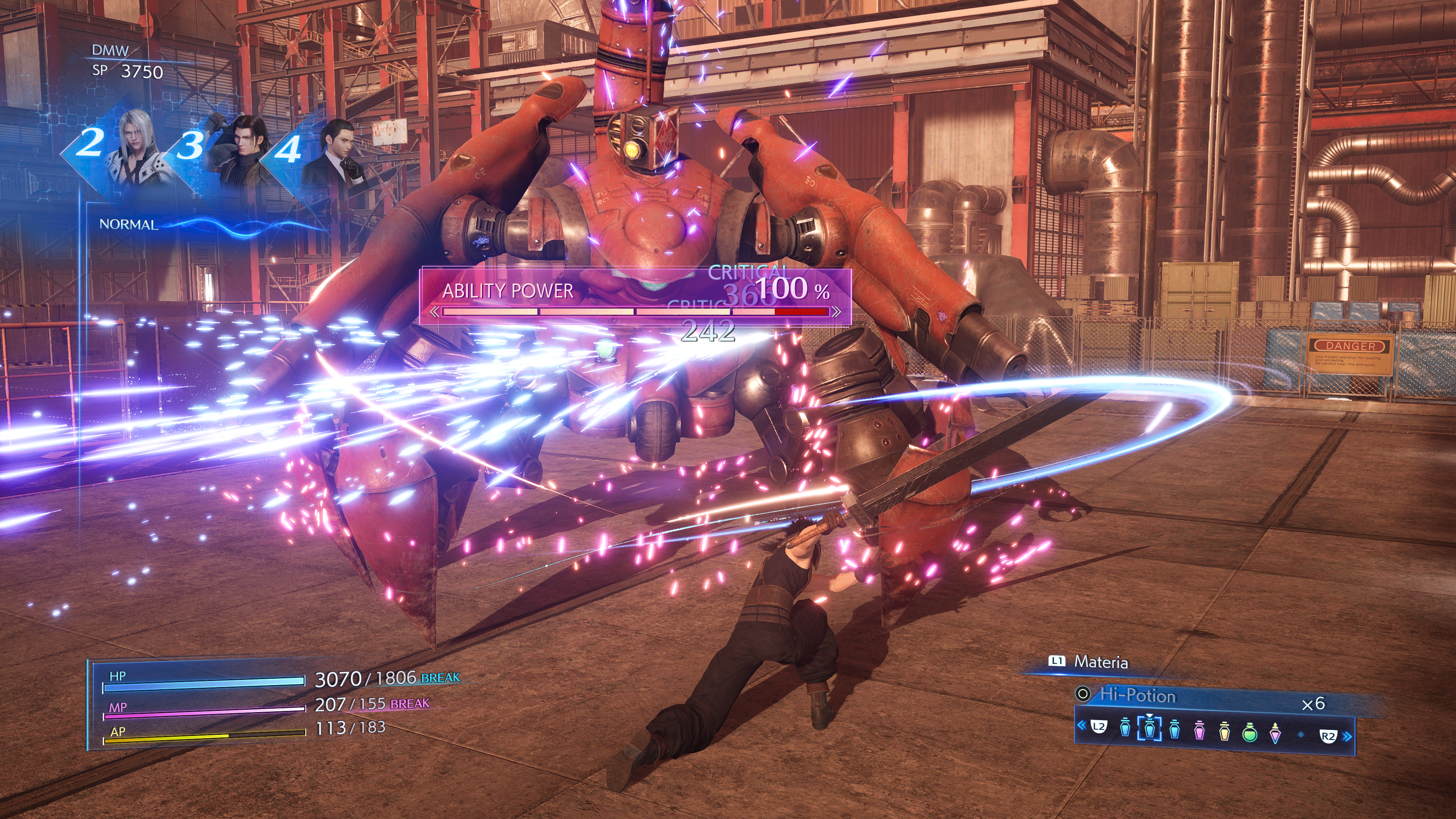
Zack has a sword at his disposal, and pressing the attack button triggers a combo. Alongside his melee moves, he can equip various Materia, ranging from the magic we already know, such as Fire and Cure, to buffs for the protagonist, such as additional health or attack, to special moves that do not consume MP but AP, such as Assault Twister, which deals physical damage. The interesting thing is seeing how all these skills can be combined. Because activating these powers is almost instantaneous, there is nothing to limit you when fighting all the enemies in front of you.
However, what really stands out in Crisis Core is the system known as Digital Mind Wave, or DMW. At all times, a pachinko machine with various numbers and images of the important characters in the story will be active. Throughout the fights, different combinations will appear on screen, granting a series of abilities and momentary upgrades. This means that, unexpectedly, Zack can become immune to damage for a short period of time or gain unlimited magic. The catch, and the reason many don’t like this concept, is that your level is also tied to luck. Enemies do not provide experience, and your attributes can only improve when the game says so.

Sure, there’s a hidden system that takes into consideration where you are in the story, but it’s common to spend hours stuck at level seven, only for a single boss fight to raise you five levels, and this applies to subjects as well. Finally, the DMW gives us access to Ultimate attacks, which are tied to Zack’s relationship with some of the characters in the story, such as Aerith and Cloud, as well as summons, which do a large amount of damage.
One thing that has also stayed true to the PSP’s legacy is the structure of Crisis Core: Final Fantasy VII Reunion. The story is split into short chapters that last no more than an hour, and there are endless side quests that hopefully take you more than a couple of minutes. This is because the original experience was built with a handheld in mind, so everything was built to play for short bursts.
The additional content is repetitive and dated. The main campaign has little variety, and it doesn’t carry over here. Each mission asks you to take out a couple of enemies, a task you can accomplish quickly. Where this iteration shines is that these sections have become bearable because you do need to complete these tasks to get better materia and equipment.
Verdict
Do not head into Crisis Core: Final Fantasy VII-Reunion- expecting anything new. Instead, welcome it as a side story about one of Cloud’s lost heroes and companions. As a remake, the graphical and quality-of-life improvements make this an excellent yet hammy spin-off. It has a lot of writing that wouldn’t fly today and serves as a time capsule of a long-gone era. It is a short experience and a vital companion to Final Fantasy VII, especially given how it ties right into the impossible ending of Remake.
[The publisher provided a copy of the game for review.]
Reviewed on: PlayStation 5